

Eastern Red Bat
Lasiurus borealis
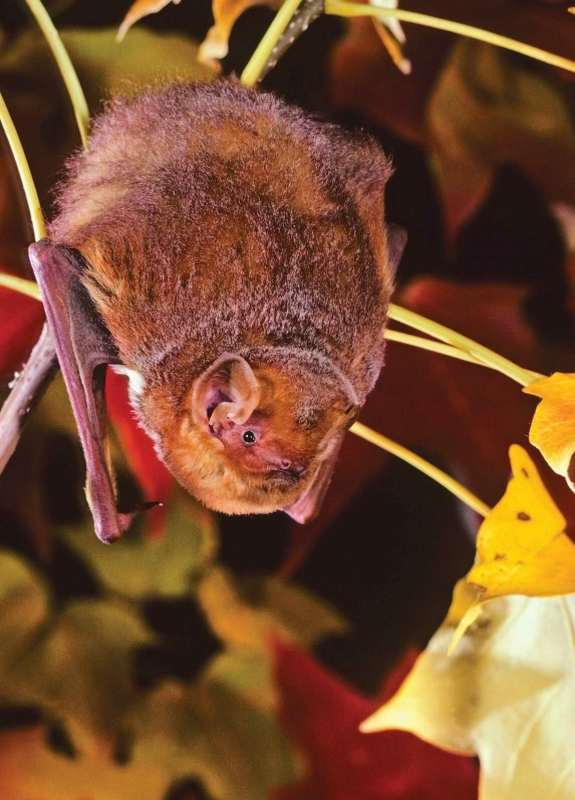
Habitat: Deciduous and mixed forests, forest edges, parks, suburban neighborhoods, and wooded riparian corridors. Eastern Red Bats typically roost alone among the leaves of trees, where their fur provides excellent camouflage.
Diet: Moths, beetles, leafhoppers, flies, and other flying insects captured in open areas and along forest edges.
Maternity Colony Size: Solitary. Females do not form maternity colonies and instead raise their pups alone, often giving birth to 1–4 young.
Winter Strategy: Migratory species that travels south for the winter rather than hibernating in caves.
Species Notes:
The Eastern Red Bat is one of the most striking bat species in North America. Males are a vibrant red-orange color, while females are generally paler with grayish tones. Their fur resembles dead leaves, allowing them to remain well hidden while roosting among tree foliage during the day.Unlike cave-hibernating bats, Eastern Red Bats migrate seasonally, moving southward in autumn and returning north during spring. Historically, large numbers were reported migrating together, sometimes visible during daylight hours. Today, such observations are uncommon, and migration typically occurs at night.
Eastern Red Bats are generally solitary throughout much of their lives. Females raise their young alone rather than forming maternity colonies, a trait that distinguishes them from many other northeastern bat species. They forage in open woodlands, forest edges, and suburban habitats, where they consume a variety of night-flying insects.
Among New York's tree-roosting bats, the Eastern Red Bat is considered one of the less frequently encountered species. Like other migratory bats, it faces conservation challenges associated with habitat loss and mortality at utility-scale wind energy facilities.
Adults typically have a wingspan of about 12 inches, a body length of approximately 2 inches, and weigh less than one ounce.